
May 14, 2025
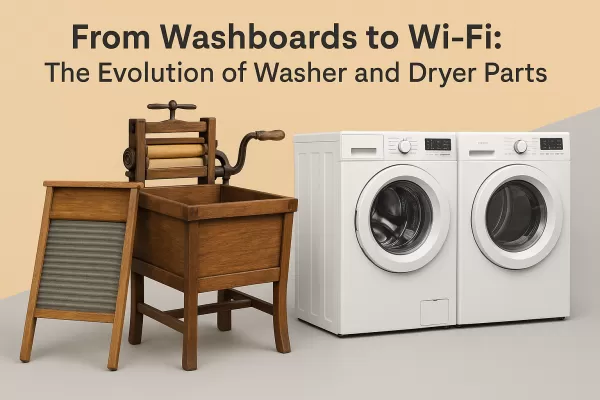
From Washboards to Wi-Fi: The Evolution of Washer and Dryer Parts
Introduction: Doing laundry has come a long way from the days of scrubbing clothes by hand and hanging them to dry. Imagine a 19th-century wash day with a heavy tub, a washboard, and hours of labor, versus today’s world where you can tap a smartphone app to start your washer. This journey from primitive wash tubs to Wi-Fi connected appliances is marked by remarkable innovations in washer and dryer parts. In this blog post, we’ll explore the historical development of washing machines and dryers, highlight key innovations in their design (motors, belts, control boards, sensors, and more), and see how the industry’s focus on energy efficiency, digital technology, and sustainability has evolved. We’ll also dive into current 2024–2025 trends – from smart appliance integration to parts sourcing challenges and the booming repair market – and how these trends are shaping the appliance parts industry.
From Hand-Cranked to Automatic: A Brief History of Laundry Appliances
In the early days, laundry was entirely manual. Until the 18th century, washing clothes meant laboriously scrubbing fabrics against rocks or washboards, then wringing and line-drying them in the sun. The first mechanical aids emerged in the late 1700s and 1800s – for example, in 1767 German scientist Jacob Christian Schäffer devised a hand-powered washing machine, and by 1797 the first US washing machine patent was filed. Early inventions were crank-operated drums and rollers that reduced some physical toil. Drying, meanwhile, was initially just clotheslines and sun. A Frenchman named Pochon invented a hand-cranked “ventilator” dryer in 1799, essentially a perforated metal drum over a fire. It wasn’t very practical – clothes often came out smoky – but it laid the groundwork with the concept of tumble drying in a drum.
The turn of the 20th century brought electric power to laundry. Electric washing machines appeared by the early 1900s, ending the era of hand-cranks. The Hurley Machine Company’s “Thor” washer in 1908 was one early electric model, featuring a galvanized drum and powered agitator. By the 1920s, electric washers were selling hundreds of thousands of units annually in the U.S., although the Great Depression slowed this growth. For dryers, the breakthrough came slightly later – in 1938 inventor J. Ross Moore introduced an affordable electric and gas dryer called the “June Day,” finally giving the public a practical way to dry laundry quickly at home. Dryer adoption took off in the post-WWII economic boom, with various brands competing and prices dropping by the 1940s.
The real revolution was full automation. In 1937, Bendix Home Appliances introduced the first domestic automatic washing machine – a drum-type washer that could wash, rinse, and spin without manual intervention. For the first time, a single machine handled an entire cycle, although early models had quirks (the original Bendix had no suspension and had to be bolted to the floor to keep it from “walking” during spin!). Automatic washers initially were costly and appeared mostly in laundromats in the 1940s and 50s, but over the 1950s and 60s they improved and spread into homes globally. By 1940, about 60% of U.S. homes with electricity had an electric washer (many still with separate wringer attachments. Dryers evolved in parallel: by the late 1940s dryers gained timers, temperature controls, and exhaust vents, and by the 1950s an important new part – the automatic dryness sensor – had been invented. This sensor could detect when clothes were dry and shut the dryer off, saving energy and preventing overdrying – a glimpse of “smart” functionality decades ago.
Through the 1960s and 1970s, both washers and dryers became mainstream and saw steady improvements. The permanent press cycle debuted in the mid-60s (helping reduce wrinkles by cooling clothes down at cycle end), and by the 1970s electronic microcontrollers began appearing in dryers to refine cycle control. Washing machines in the 1970s transitioned from electromechanical timers to early electronic controls as well, and designers added more specialized cycles (the delicate “wool” cycle, for instance, arrived in the 1990s). The 1980s brought a wave of miniaturized electronics – washers started using microprocessors and memory to manage cycles, enabling finer control of water use and spin speed for efficiency. By the late 20th century, the familiar appliance designs – a washer with multiple wash presets and a dryer with auto-sense drying – were well established, setting the stage for the digital age to come.
Key Innovations in Washer and Dryer Parts
Many of the advances in laundry appliances were driven by innovations in specific components. Let’s look at several key washer/dryer parts and how they evolved:
-
Motors and Drive Systems: Early washing machines used simple AC motors with belts or gears to drive the drum. A major innovation was the direct-drive motor, which mounts the motor directly to the drum, eliminating belts and pulleys. First introduced by Fisher & Paykel in 1991, direct-drive motors reduced noise and maintenance (no belts to replace). Modern washers often use inverter-controlled brushless DC motors, offering variable speeds for gentler washes and high-speed spins with better energy efficiency. Dryers still commonly use belt drives, but their motors have also improved in efficiency and reliability.
-
Belts and Mechanical Parts: In traditional designs, a rubber belt transfers motor power to spin the wash drum or dryer drum. Over time, belt materials have improved to last longer under heat and stress. Notably, because direct-drive washers eliminate the main drive belt, they removed a frequent point of failure – an engineering choice that improves durability. Other mechanical parts like suspension springs or dampers were introduced (especially in front-load washers) to steady high-speed spins, and modern washers even use ball-bearing balancing rings or liquid shock absorbers to counter drum vibration.
-
Thermostats and Sensors: Basic thermostats have long regulated dryer temperatures, but now precise electronic temperature sensors (thermistors) monitor heat. The introduction of moisture sensors in dryers (starting in the 1950s as noted) was revolutionary – these sensors detect humidity in the drum and allow the dryer to stop when clothes are dry. Similarly, washing machines have used water level pressure switches for decades to sense how full the tub is. Today’s appliances include a variety of sensors: weight sensors to detect load size, speed sensors to detect off-balance loads, and even turbidity sensors that gauge how dirty the wash water is. These all enable the machine’s control system to adjust operation on the fly for better results.
-
Control Boards (Brains of the Machine): Perhaps the most dramatic change in appliance parts has been the evolution of controls from mechanical timers to digital control boards. Mid-century automatic washers used motorized cam-and-switch timers to sequence wash cycles. In the 1970s and especially by the 1980s, electronic microcontroller boards began taking over cycle control. Modern washers and dryers use printed circuit board controllers (PCBs) with integrated circuits that not only manage timing, but also store dozens of cycle programs and interface with sensors. These boards are essentially small computers – they enabled features like push-button presets, LED or touchscreen displays, and later on, connectivity. The move to solid-state controls improved precision (for example, controlling water fill to the exact liter) and allowed quick updates: e.g. adding a child-lock or a custom cycle was just a software tweak, not a mechanical re-design.
-
Materials and Build: Over time, the parts inside washers and dryers also benefited from better materials. Stainless steel replaced porcelain or aluminum for wash tubs and dryer drums, preventing rust. High-performance plastics are now used in parts like pump housings and fan blades to resist corrosion and reduce weight. Even belt materials and seals improved, extending the life of components. These material advances often fly under the radar but contribute to modern machines lasting longer and requiring fewer repairs.
In short, the machinery inside laundry appliances became more efficient, reliable, and intelligent through these part innovations. A 2024-era washer has far more sensing and computing power than the simple electro-mechanical washers of the 1950s – yet the core goal remains the same: agitate, rinse or heat, and tumble clothes as effectively as possible.
Energy Efficiency and Eco-Friendly Design
Laundry appliances have faced increasing pressure to do their job while using less water and energy. Over decades, manufacturers have redesigned parts and processes to make washers and dryers more eco-friendly without sacrificing performance.
Clothes washers saw some of the biggest efficiency gains by switching designs. Traditional top-loading washers with a central agitator are efficient at cleaning but use a lot of water and energy. The rise of front-loading washers (and high-efficiency top-loaders without agitators) changed that. Front-loaders can clean clothes with tumbling action and gravity, needing much less water – and they spin faster, extracting more water to lighten the dryer’s work. By using sensors and smarter controls, modern washers optimize every cycle. For example, many have load-sensing: the washer weighs or senses the laundry load and adjusts the water level accordingly, so you don’t waste water on a half-full drum. Temperature sensors and variable-speed motors let the machine tailor the agitation intensity and spin speed to the fabric type, so cycles are not overlong or overpowered.
The numbers tell the story of progress. A new Energy Star certified washer today uses about 25% less energy and 33% less water than a standard model, thanks to advanced features and smarter operation. In fact, according to Consumer Reports, modern front-load washers use dramatically less water than older agitator washers – on the order of 70% less water and 25% less energy than washers from 20 years ago. These efficiency gains come from innovations like inverter drive motors (which only draw as much power as needed at any given moment), insulated cabinets to enable higher-temperature washes with less heating power, and better drum designs that lift and drop clothes efficiently. Even the introduction of steam in some washers (to help lift stains at lower water temperatures) and recycling rinse water for multiple uses in high-end models are aimed at saving resources.
Dryers historically were energy hogs – essentially big resistive heaters or gas burners. To improve, manufacturers added auto-dry sensors (preventing the dryer from running longer than necessary) and improved airflow design to dry faster. A recent leap in dryer efficiency is the adoption of heat pump dryers, common in Europe and now appearing in North America. These dryers use a refrigerant loop to dehumidify and recycle heat rather than venting hot air outside. The result is up to 50% energy savings, and they can dry clothes at lower temperatures, gentler on fabrics. Heat pump dryers eliminate the need for an external vent as well, adding flexibility in installation. Other eco-friendly tweaks include improved drum insulation and motor efficiency so that more of the energy goes into drying clothes and less is lost as heat or vibration.
Beyond energy and water, sustainability also means designing appliances to last longer and be less wasteful. This has influenced parts design in subtle ways. For instance, some brands now advertise using recycled plastics or sustainably sourced metals in certain components. There’s also a push (often due to regulations we’ll discuss later) to make parts replaceable instead of disposable – for example, designing a washer’s bearing or motor so it can be replaced independently, rather than junking the whole machine. The environmental benefit is significant: better efficiency standards for washers taking effect in the U.S. by 2028 are expected to prevent millions of metric tons of carbon emissions and save huge amounts of water. And every appliance kept running in service instead of sent to a landfill helps avoid waste and the energy cost of manufacturing a replacement.
The Digital Transformation: Smart Features and Connectivity
The late 20th century’s electronic controls were just the start – the 21st century has brought smart technology into laundry rooms. Modern washers and dryers increasingly feature digital displays, automation, and even internet connectivity, turning what used to be “dumb” mechanical boxes into IoT devices.
Today’s high-end appliances often come with Wi-Fi or Bluetooth connectivity and companion smartphone apps. This means you can monitor and control your laundry remotely – for instance, receive a notification on your phone when the cycle is done, or start the dryer while you’re still at the grocery store. Major manufacturers have rolled out these capabilities: for example, Samsung’s SmartThings app lets users start/stop cycles and get alerts from their connected washer or dryer via phone. LG and GE have similar smart platforms. These features are more than a gimmick; they add convenience (no more forgetting wet clothes overnight) and can even save energy by allowing integration with smart home systems. Some smart washers can coordinate with home energy management systems or smart grids – they can delay a cycle to run during off-peak cheaper electricity hours, for instance.
Beyond connectivity, the “brain” inside appliances has gotten much smarter with advances in sensors and software (often labeled as AI or machine learning features in marketing). Adaptive wash cycles use algorithms to adjust how the machine operates based on the load. An AI-powered washer might detect, say, that you’ve put in a load of delicate blouses and automatically choose a gentler wash motion and lower spin speed. Or it might sense extra dirt in the water (via a turbidity sensor) and extend the wash time for better cleaning. Some models even claim to “learn” your household’s typical laundry patterns and suggest optimal cycles. While some of these capabilities are nascent, the trend is clear: washers and dryers can make more decisions automatically now.
Another digital innovation is the inclusion of touchscreens and voice control. Instead of analog dials, you might see full-color touch displays on a washer that guide you through cycle selection with animations and tips. A few appliances integrate with voice assistants – for example, you could say “Alexa, how much time is left on the dryer?” and get a response, or even start a cycle with a voice command. Under the hood, these conveniences all rely on the sophisticated control boards and software now standard in appliance design.
Crucially, smart technology also aids in maintenance. Many appliances can perform self-diagnostics – if a sensor detects a problem (like a vent clog or an imbalanced drum), the machine might display an error code or send a notification. Some brands allow remote troubleshooting: the appliance can transmit diagnostic data to a technician or app. This can simplify repairs (the technician knows what part to bring) or even prevent damage by alerting owners to issues early (like reminding you to clean the lint filter to avoid overheating).
All these digital features illustrate how washer and dryer parts now include not just pumps and motors but also processors, wireless chips, and advanced sensors. The line between appliance and computer has blurred. While the fundamental mechanical parts still do the washing and drying, the coordination and control are more high-tech than ever, enabling efficiency and user-friendly touches that were unimaginable a few decades ago.
Trends Shaping the Laundry Industry in 2024–2025
As we reach the mid-2020s, several major trends are influencing how washers, dryers, and their parts are designed, produced, and maintained. Here’s a look at the current landscape and its impact on the appliance parts market:
-
Smart Appliance Integration: The push toward smart homes means laundry appliances are increasingly designed to integrate with other devices and systems. In 2024, it’s common to see washers and dryers that pair with smartphone apps and smart speakers. This integration is driving demand for electronic parts like Wi-Fi modules, sophisticated control boards, and sensors. It also opens opportunities for new services – for example, appliances that can self-order replacement parts or supplies. (Some modern machines already can notify you to buy more detergent, or in the future could schedule their own maintenance.) The trend of connectivity means part suppliers must consider stocking more digital components and even firmware updates, not just mechanical parts. Users now expect their washer’s “brain” to be as advanced as their phone, and manufacturers are racing to provide that seamless experience.
-
Sourcing Challenges and Supply Chain Pressures: The past few years have taught the appliance industry hard lessons about supply chains. The COVID-19 pandemic and global logistics issues led to shortages of key components for appliances, from semiconductors for control boards to simple parts like seals and bearings. Even in 2023, technicians reported scarcity of spare parts needed for repairs, causing delays and higher costs. In 2024–2025, geopolitical factors (trade tensions, tariffs) are also impacting sourcing. Tariffs on imported appliances have raised costs, which ironically makes repairing older units more attractive to consumers. As one industry source noted, “With tariffs inflating the price of appliances…the gap between the cost of repair and replacement continues to widen,” leading more people to opt for repairs. For the parts market, this means a surge in demand for replacement parts but also challenges in obtaining them quickly. Manufacturers and parts distributors are responding by strategic stockpiling of critical components and diversifying their supplier base. Some are turning to local sourcing for parts to reduce dependency on global shipping. Overall, managing the supply chain for appliance parts has become a top priority – availability of parts can make or break customer satisfaction when an appliance breaks down.
-
Booming Repair Market and DIY Demand: As new appliance prices rise and sustainability mindsets grow, consumers are increasingly choosing to repair rather than replace their washers and dryers. There’s a growing emphasis on repairing faulty appliances instead of discarding them. This is creating what some call a “repair-friendly economy”. Independent repair businesses are seeing high demand, and even DIY repairs are on the rise thanks to online tutorials and readily available parts. The parts industry is adapting by making parts more accessible to consumers and repair techs alike – for example, providing online parts catalogs, exploded diagrams, and fast shipping to get parts in hand quickly. Companies like Encompass Supply Chain have noted that e-commerce and how-to videos empower consumers to fix appliances themselves, enlarging the DIY segment of the market. All of this increased repair activity means a healthy demand for appliance parts, from common wear items (belts, door gaskets, heating elements) to sophisticated components like circuit boards. It also means manufacturers are paying more attention to supporting repairs – some OEMs now embrace the idea of an extended product lifecycle as a boost to brand reputation and sustainability. In short, fixing is “in,” and that trend directly fuels the appliance parts sector.
-
Regulatory and Environmental Pressures: Governments and consumers are pushing for appliances that are not only efficient but also sustainable and durable. In the EU, new “right to repair” regulations that took effect in 2021 require manufacturers to make spare parts available for up to 10 years for products like washing machines and dryers. This means appliance makers must ensure a long-term supply of parts (such as motors, pumps, electronic boards) and design machines such that those parts can be replaced with standard tools. Even if these specific EU rules don’t apply globally, the philosophy is spreading. California enacted a Right to Repair law (albeit focused on electronics) in 2024, and other regions are considering similar legislation. For the appliance parts market, right-to-repair laws are a boon: they virtually guarantee a steady need for replacement parts and technical documentation, and they discourage the practice of “sealed” proprietary components that can’t be swapped out. Environmental regulations are also shaping appliance design. One timely example: France’s law requiring microplastic filters in all new washing machines by January 2025. This law, aimed at preventing microfiber pollution from synthetic clothes, means manufacturers have to incorporate a new filter component into washer designs sold in France. If other countries follow suit, a whole new category of appliance part (microfiber filter units and cartridges) will become standard. Likewise, ever-tightening energy efficiency standards push companies to innovate parts like more efficient motors, insulation, and heat pump systems. All these pressures mean that the appliance industry must be more agile in its design and part supply. The winners will be companies that can balance compliance with these rules while still delivering quality and value. And for consumers and the planet, these changes are largely positive – appliances that last longer, use less resources, and don’t end up as quickly in the scrap heap.
Conclusion: Adapting to a Changing Laundry Landscape
From the wooden washboard to the Wi-Fi enabled washer, the evolution of laundry appliances reflects a broader story of technological progress. Each era introduced new and improved parts – a better motor here, a smarter sensor there – building on the legacy of inventors who sought to make laundry less of a chore. The result today is that we have incredibly capable washers and dryers that our great-grandparents would marvel at. But this story is still unfolding. The current trends of 2024–2025 show an industry in transition: embracing smart connectivity, navigating global supply challenges, responding to consumers’ desire to repair and reuse, and meeting calls for sustainability. All of these forces are shaping the appliance parts market in real time. We’re seeing a greater emphasis on high-tech components, a need for resilient supply chains for those components, and a recognition that supporting repairs (through readily available parts and information) is now part of doing business responsibly.
For companies in the appliance parts sector, these trends mean opportunity. A “repair-friendly” world is one where having the right part at the right time is immensely valuable – whether it’s a classic drive belt for a 20-year-old dryer or a specialized control board for the latest smart washer. We’re likely to see continued innovation in the parts themselves too, spurred by energy goals and digital integration. Perhaps the next decade will bring even more advanced sensors or self-healing components that further reduce breakdowns.
One thing is certain: as long as people need clean clothes, washers and dryers will remain indispensable. And behind every reliable load of laundry is a whole network of innovations and parts working in concert. By understanding how these machines evolved and keeping an eye on current developments, we can appreciate the engineering marvels in our laundry rooms – and be prepared for the next spin in the ongoing evolution of washer and dryer technology.